Every site served locally. Every site managed from one console
Almost every service is moving to the cloud, but DHCP still has to be served on site. DNSBOX takes DHCP and DNS off Windows and onto dedicated, low-cost appliances, one at each site and sized to it. You manage the whole estate from a single view, and hub-and-spoke failover protects every site without a redundant pair at each one.
One view across every site, whichever appliance is serving
Central management is provided by DNSBOX400. Changes are made centrally on the DNSBOX400 and pushed automatically to the appliances in the field. Each site keeps serving its own leases locally, so day-to-day DHCP never depends on the WAN.
- One console for the whole estate. See subnets, lease use and configuration on every appliance in one place.
- Central changes, local serving. Make a change once and it applies everywhere.
- Secure remote access. Access appliances without exposing them to the internet.
- Delegated administration with a full audit trail. Share day-to-day work with site or regional teams while keeping central control.
- No Active Directory dependency. Work with on premises AD or Entra ID.
- Minimal patching scoped only to DHCP. No DC dependency, no licences for features you don't need.
More on central DHCP management →
Failover for every site, without doubling the appliance count
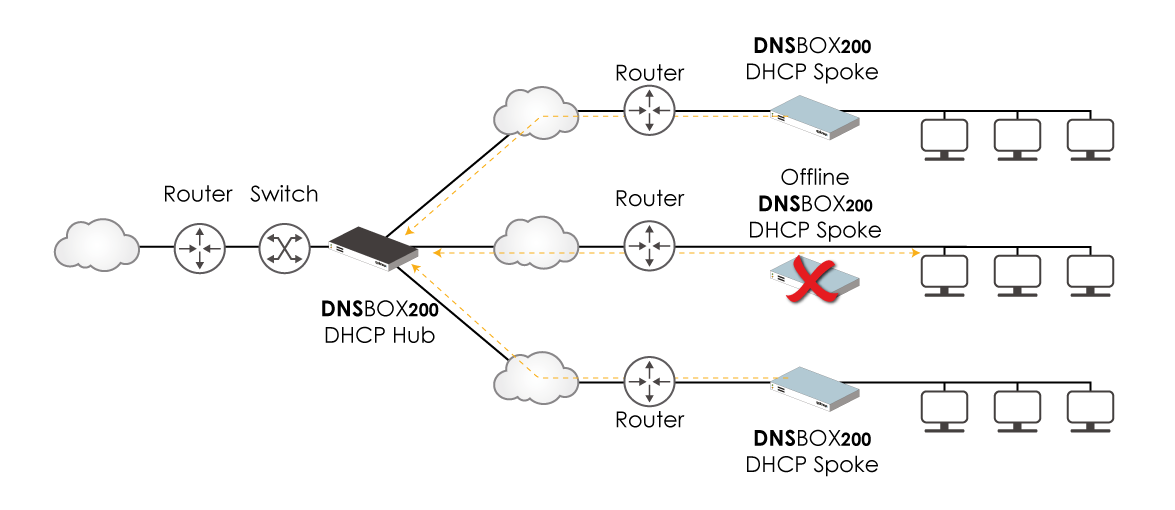
A redundant pair at every site is expensive, and small sites rarely justify one. With hub-and-spoke, one heavier-duty hub backs every low-cost site appliance in its region at once. If any site appliance becomes unavailable, the hub takes over serving DHCP for that site within seconds.
|
|
How a multi-site organisation runs it
Whether the sites are schools, campuses, branch offices, stores, clinics or government buildings, the pattern is the same. Each site gets a single appliance sized to it, with a hub in the regional office or data centre and a DNSBOX400 for central management. The network team makes scope and reservation changes once, centrally. Each site keeps issuing its own leases. If a site's appliance fails, the hub takes over for that site within seconds while a spare is swapped in. A new site is just one more low-cost appliance, managed from the same console.
Chosen by organisations in every sector, from school districts and universities to enterprises and the public sector, running dozens of sites with small central teams. Customers commonly run one DNSBOX deployment for ten years or more, through low-cost hardware refreshes with no migration.
Map your sites with a DHCP specialist
Send us your site list and rough user counts. We'll sketch a right-sized design: where a site needs its own appliance, where the hub covers it, and how it grows. No obligation, and you talk to an engineer, not a call centre.
Book a 20-minute design call +1 512 696 1420 (US) · +44 (0)8454 50 51 52 (UK)
 When its new network switches dropped DHCP functionality the USA's largest manufacturing plant were left without without IP tracking for its production lines. DNSBOX gave them central visibility of all DHCP scopes across the plant
 I love a product that just does what it's supposed to do with minimum fuss – a redundant, reliable DHCP service.
© 2001-2026 ApplianSys
